

SLU-PP-332 gets filed under peptides almost everywhere it is sold, including here. It is worth saying up front that it is not one. It is a synthetic small molecule, and the difference changes how it behaves, how it is handled, and what the research on it means.
It is also one of the more interesting compounds to come out of metabolic research in the last few years, mostly because of a set of mouse studies where treated animals ran dramatically further than untreated ones without training. Here is what is actually known.
It is not a peptide
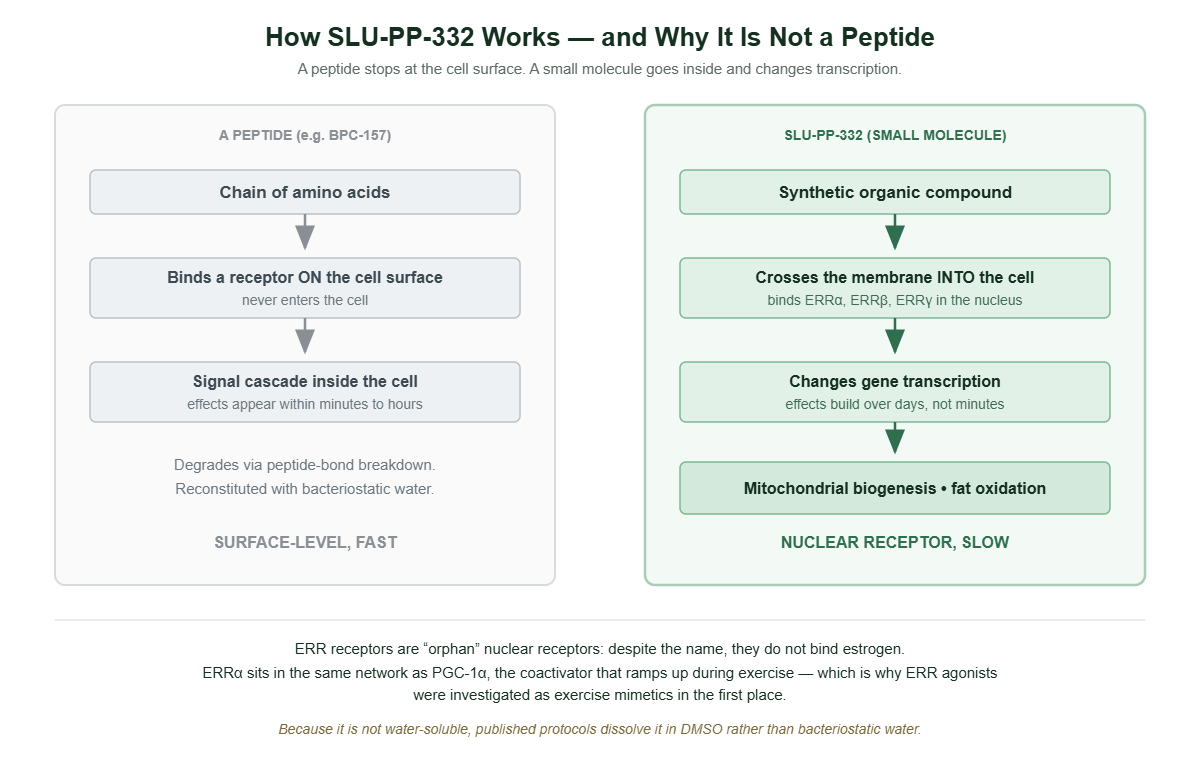
Peptides are chains of amino acids. SLU-PP-332 is not — it is a small synthetic organic molecule, closer in kind to a conventional drug candidate than to BPC-157 or TB-500.
The practical differences matter:
- It acts on a nuclear receptor inside the cell, not a surface receptor. It has to cross the cell membrane to do anything.
- It changes gene transcription, so effects build over days rather than appearing within minutes.
- It does not degrade the way peptide bonds do, so its stability profile is different — though it is still handled cold in research settings.
The name comes from Saint Louis University, where it was developed in the lab of Thomas Burris. Burris later moved to the University of Florida, which is where much of the follow-up work was published.
What it targets
SLU-PP-332 is a pan-agonist of the estrogen-related receptors: ERRα, ERRβ, and ERRγ.
Despite the name, these have essentially nothing to do with estrogen. They are orphan nuclear receptors — they resemble the estrogen receptor structurally but do not bind estrogen and had no known natural ligand when they were identified. They regulate mitochondrial biogenesis and oxidative metabolism, and they are most active in tissues that burn a lot of energy: skeletal muscle, heart, brown fat.
ERRα in particular sits in the same regulatory network as PGC-1α, the coactivator that ramps up when you exercise. That overlap is the entire reason anyone looked at ERR agonists as exercise mimetics. If exercise works partly by turning up this pathway, a compound that turns up the same pathway directly is at least worth testing.
What the mouse research showed
The headline result, published in 2023, is the running one. Mice given SLU-PP-332 ran substantially longer and further on a treadmill than untreated mice — reported at roughly 45% longer in duration and about 70% further in distance. These were sedentary animals; no training was involved.
Muscle tissue from treated mice showed increased mitochondrial activity and a shift toward oxidative, fatigue-resistant muscle fibre characteristics — the fibre type endurance training produces.
A second line of work looked at metabolic syndrome in diet-induced obese mice. Treated animals lost fat mass and showed improved glucose handling. The mechanism is worth noting: food intake did not drop. The effect came from increased fatty acid oxidation, not appetite suppression — which is a genuinely different mechanism from GLP-1 compounds like semaglutide or retatrutide, where reduced intake does most of the work.
There has also been work in heart failure models, on the reasoning that failing cardiac tissue has impaired oxidative metabolism and ERR activation might address it.

What is not known
This is the part that gets skipped in most write-ups, so it is worth being direct.
There are no human trials. None. Every result above is from rodents. SLU-PP-332 has not been through Phase I, and there is no published human safety, tolerability, or pharmacokinetic data.
There is no established human dose. Anyone quoting one is extrapolating from mouse studies, which is not a valid basis for a human figure. The published work used intraperitoneal injection in mice, twice daily.
Oral bioavailability is poor and the half-life is short. Both were noted as limitations in the original work, and both are reasons the compound has not moved forward as a drug candidate in its current form. Follow-up chemistry has focused on analogues with better properties.
Long-term effects are unstudied. ERR receptors regulate metabolism across many tissues. A pan-agonist activates all three subtypes everywhere they are expressed, and the consequences of doing that for months have not been characterised in any species.
The compound is a research tool. That is what it was made for and what the literature supports.
Handling in the lab
SLU-PP-332 is supplied as a lyophilized powder. Because it is a small molecule rather than a peptide, it is poorly soluble in water — published protocols use DMSO as the primary solvent, then dilute into an aqueous carrier.
General handling:
- Powder: -20°C, protected from light.
- Stock solution: prepared in DMSO, aliquoted, stored frozen. Aliquot rather than repeatedly freezing and thawing one vial.
- Working dilutions: prepared fresh. Aqueous dilutions are not stable for long.
The reconstitution mechanics are otherwise the same as anything else lyophilized — solvent down the vial wall, swirl rather than shake, no direct stream onto the powder. Our guides on reconstitution and storage cover the general process, and the dosage calculators handle the concentration maths.
Where it stands
SLU-PP-332 is a real finding — a compound that reproduces part of the endurance-training response in mice through a clearly identified mechanism, without touching appetite. That is scientifically interesting and worth following.
It is also entirely preclinical, with known pharmacokinetic limitations and no human data at all. Both of those things are true at once, and any source telling you only the first half is selling something.
Our SLU-PP-332 5mg is third-party tested with COA available, same as everything in the catalogue.
Intended for laboratory research purposes only. Not for human consumption. Nothing above is medical advice.