

Search this question and you get two answers, both wrong. One says peptides are perfectly legal because collagen is sold at Costco. The other says they are banned. Neither is right, because “peptide” is a chemistry word, not a legal category.
A peptide is just a short chain of amino acids. Insulin is a peptide. So is the collagen in your protein powder. So is BPC-157. Those three things sit in three completely different places under Canadian law, and that is the whole answer to this question.
Below is how the categories actually break down. This is general information about how the rules are structured, not legal advice, and we are a supplier rather than a neutral party. Read the Health Canada material yourself before you rely on any of it.
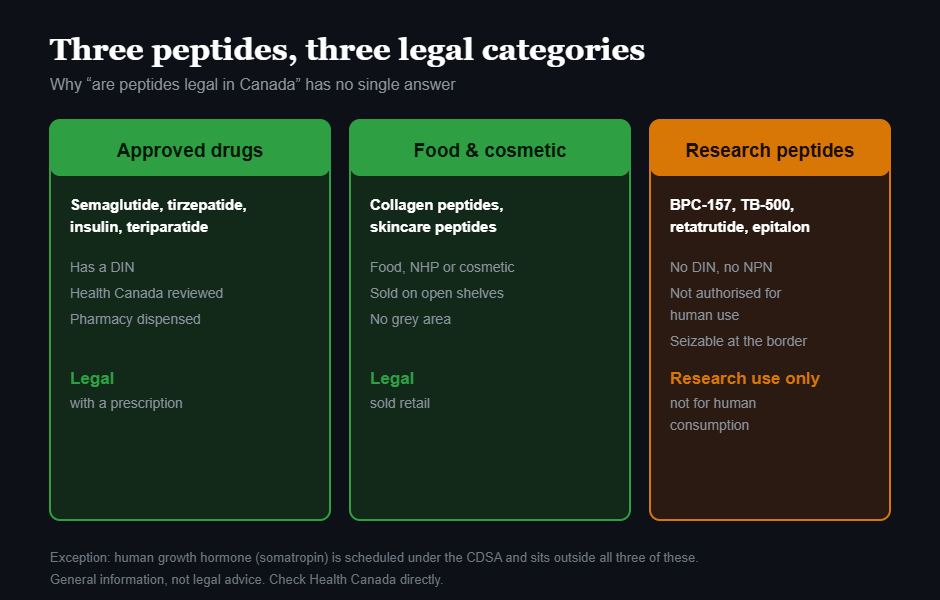
The three categories
1. Approved prescription drugs
Some peptides have gone through Health Canada review, carry a Drug Identification Number (DIN), and are legal to sell and use with a prescription. Semaglutide, tirzepatide, liraglutide, insulin, teriparatide and tesamorelin all sit here.
These are legal, fully regulated, and dispensed by licensed pharmacies. If you want one, the route is a prescriber and a pharmacy. Anything else selling them is operating outside that system. We covered the practical side in how to find GLP-1 in Canada and in the semaglutide profile.
2. Food and cosmetic peptides
Collagen peptides, whey peptides and the peptide ingredients in skincare are regulated as foods, natural health products or cosmetics. They are sold openly on shelves and there is no grey area. This is the category people point to when they say “peptides are legal,” and they are right, about this category only.
3. Unapproved peptides sold for research
This is the group most people mean when they search the question. BPC-157, TB-500, ipamorelin, CJC-1295, epitalon, MOTS-c, retatrutide, SLU-PP-332 and the rest.
None of these have a DIN or an NPN. Health Canada has not authorised any of them for human use, and none are approved ingredients in a licensed supplement. Under the Food and Drugs Act it is an offence to sell or advertise an unauthorised drug for human use in Canada, which is precisely why every legitimate supplier in this country, us included, labels them for research use and not for human consumption.
That label is not a wink or a marketing device. It is the actual reason these products can be sold at all, and a vendor who tells you otherwise is telling you something untrue.
Where the line actually sits
The distinction that trips people up is between selling and possessing.
Most peptides are not controlled substances. They are not scheduled under the Controlled Drugs and Substances Act, so they are not in the same legal universe as a controlled drug, and simple possession is not a CDSA offence. What the Food and Drugs Act regulates is the sale, import and advertising of unauthorised drugs. That is a regulatory framework aimed at sellers, not a criminal one aimed at individuals.
There is at least one important exception. Human growth hormone (somatropin) is listed under the CDSA in Canada, which puts it in a different and much stricter category than the research peptides above. Do not assume the general rule covers it. If HGH is what you are actually asking about, look it up specifically.
Importing is where it goes wrong
If there is one practical thing worth taking from this article, it is this: the border is where unauthorised health products get stopped.
The CBSA can detain and seize unauthorised health products arriving from outside Canada, and personal-importation allowances are narrower than most people assume. An order shipping from overseas is exposed to that. An order moving between two Canadian addresses is not, because it never crosses a border.
That is the single biggest practical argument for buying domestically, and it has nothing to do with quality.
Health Canada has flagged this category
Health Canada has published advisories about unauthorised peptide products sold online, including cases where testing found the contents did not match the label. That is worth understanding as a buyer, because it reframes the real risk.
The risk in this category is usually not a knock at the door. It is paying for one compound and receiving something else, or something underdosed, or something contaminated. That is a sourcing problem, and it is the problem you can actually do something about, by insisting on a certificate of analysis whose batch number matches the vial you were sent.
Common questions
Can I be charged for ordering peptides in Canada?
The Food and Drugs Act framework is aimed at the sale, import and advertising of unauthorised drugs rather than at individual possession, and most peptides are not scheduled under the CDSA. Seizure at the border is the realistic outcome people encounter. HGH is a genuine exception, as above.
Why does every site say “research use only”?
Because that is the basis on which they can legally be sold at all. It is a statement about regulatory status, not a disclaimer someone added for style.
Are GLP-1 peptides legal?
The approved ones are legal with a prescription, through a pharmacy. Research-grade versions of the same class, and investigational compounds like retatrutide, are not approved for human use.
Is buying domestically actually different?
For customs exposure, yes, materially. A domestic parcel does not cross a border. It does not change the regulatory status of the compound itself.
Does any of this mean a peptide is safe?
No. Legal status and safety are separate questions, and an unapproved compound is unapproved precisely because that review has not happened.
The short version
Approved peptide drugs are legal by prescription. Collagen and cosmetic peptides are legal on the shelf. Everything else is unapproved for human use in Canada and is sold as a research chemical, which is why it is labelled that way. The framework targets sellers and importers rather than individual possession, HGH excepted, and the border is where problems actually happen.
If you are buying, the thing worth your attention is not the legal question, which is settled and unglamorous. It is whether the vendor can show you a certificate of analysis that matches your batch. Start with our guides to peptides in Canada and how to store peptides once it arrives.