


How to Reconstitute Peptides
For academic laboratories and independent researchers exploring the potential of advanced metabolic and tissue-repair compounds, receiving a vial of lyophilized powder is only the first step. The true foundation of any successful clinical study lies in the preparation.
Proper peptide reconstitution—mixing freeze-dried peptide powder with a sterile solvent like Bacteriostatic Water—is what guarantees clinical accuracy and maintains the structural integrity of the compound. A minor error during this process can shear delicate amino acid bonds or introduce contamination, rendering the data useless.
This guide covers the exact step-by-step mixing process, safe storage protocols, and how to utilize digital dosage calculators to ensure flawless microgram accuracy in your research.
Why Are Peptides Sold as Lyophilized Powder?
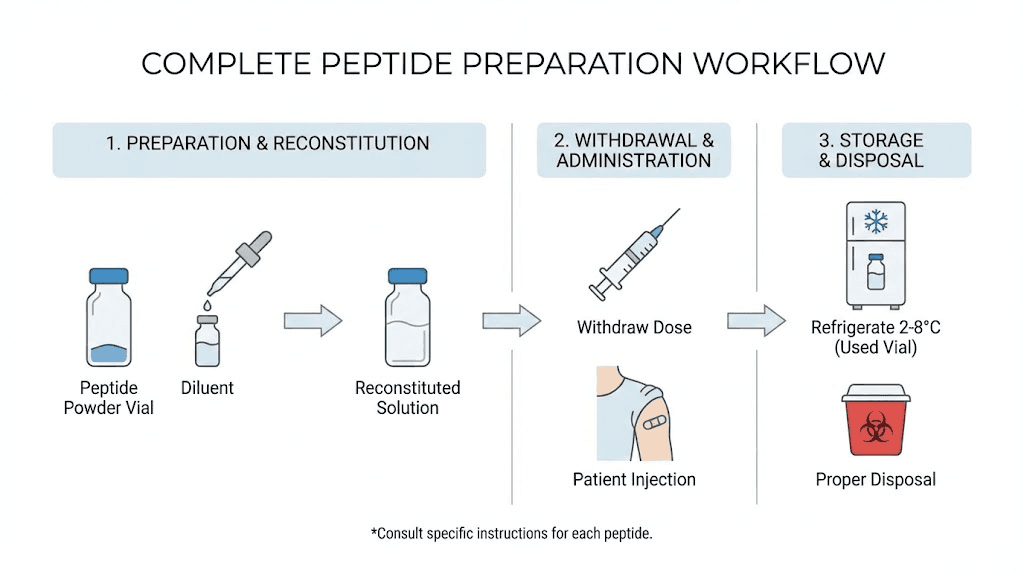
Research peptides are rarely shipped in a liquid state. Instead, they undergo a process called lyophilization (freeze-drying).
Liquid peptides are highly unstable; they degrade rapidly when exposed to agitation or the fluctuating temperatures typical of standard shipping routes—especially across varying Canadian climates. The lyophilization process extracts the moisture from the peptide while preserving its fragile molecular structure.
This ensures that researchers receive a compound with 99%+ verified purity and a maximized shelf-life, remaining completely dormant and stable until the researcher is ready to activate it for their protocol.
Essential Lab Supplies for Reconstitution
Before beginning the reconstitution process, it is vital to have the correct clinical tools prepared in a sterile environment. Utilizing subpar supplies can introduce bacteria or compromise dosage accuracy.
- Bacteriostatic Water (BAC Water): This is the industry-standard solvent for research peptides. Unlike standard sterile water (which is strictly for single-use applications), BAC water contains 0.9% benzyl alcohol. This crucial additive inhibits the growth of bacteria, allowing a single reconstituted vial to be drawn from multiple times safely.
- Insulin Syringes (U-100): The standard tool for precise measurement. A U-100 syringe holds exactly 1 milliliter (1ml) of liquid, divided into 100 visible “tick marks” (International Units or IU).
- Alcohol Prep Pads: Essential for maintaining laboratory sterility by swabbing vial stoppers before every needle insertion.
Step-by-Step: How to Reconstitute Peptides Safely
The actual mixing of the peptide is a delicate process. Peptides are composed of fragile amino acid chains that can be easily damaged by aggressive handling. Follow this strict protocol to preserve the compound’s integrity:
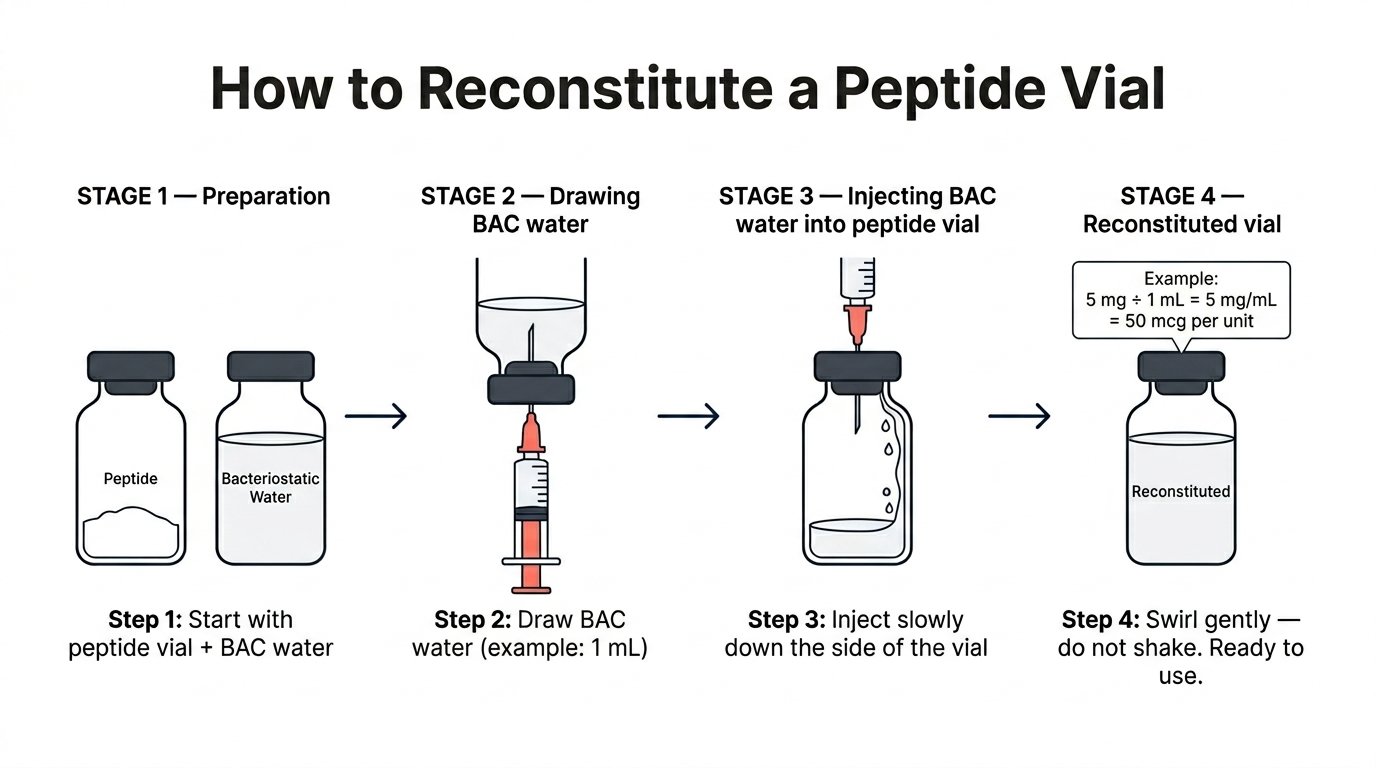
Step 1: Preparation & Sterility Begin by washing your hands thoroughly. Remove the plastic flip-caps from both your peptide vial and your Bacteriostatic Water vial. Use a fresh alcohol prep pad to firmly swab the rubber stoppers of both vials. Allow the alcohol to evaporate completely (about 15 seconds) before proceeding.
Step 2: Drawing the Solvent Take a sterile U-100 syringe and draw your predetermined volume of air into it (e.g., 1ml). Pierce the rubber stopper of the BAC water vial and inject the air into the vial to equalize the pressure. Invert the vial and draw out the exact amount of BAC water required for your specific reconstitution ratio.
Step 3: The “Drip” Method This is the most critical step. Insert the needle containing the BAC water into the lyophilized peptide vial. Do not spray the water directly onto the powder block. The physical force of a direct spray can shear and destroy the peptide bonds. Instead, angle the needle so the tip touches the inner glass wall of the vial. Slowly push the plunger, allowing the water to drip gently down the side of the glass and pool into the powder at the bottom.
Step 4: Dissolving the Compound Remove the syringe. Do not shake the vial. Aggressive shaking will create a cloudy, frothy mixture and damage the peptide structure. Instead, hold the vial gently between your fingers and swirl it in a slow, circular motion until the powder is completely dissolved. A properly mixed, high-purity peptide will yield a crystal-clear solution.
Mastering the Math: Removing Guesswork from Dosage
One of the most common points of failure in peptide research is the mathematics of dosing. Researchers often struggle to convert the milligrams (mg) of powder in the vial into the micrograms (mcg) required for their syringe.
For example: If you have a 5mg vial of BPC-157 and you add 2ml of BAC water, how many IU “tick marks” on the syringe equals a precise 250mcg dose?
Guessing these conversions compromises the integrity of your data. To eliminate this risk, researchers should utilize specialized digital conversion tools. By using the Peptide Fire Dosage Calculators, you can simply input your vial’s milligram count and your added water volume to instantly generate a precise, visual syringe guide.
Peptide Storage: Maximizing Shelf-Life
Understanding how to store your compounds is just as important as knowing how to mix them.
- Unmixed (Lyophilized): In its powdered form, the peptide is highly stable. It can be stored at room temperature away from direct sunlight for several weeks. For long-term storage (12 to 24 months), lyophilized vials should be kept in the freezer.
- Mixed (Reconstituted): Once the peptide has been introduced to Bacteriostatic Water, the clock begins ticking. Reconstituted peptides must be stored in the refrigerator (between 2°C to 8°C). Even when refrigerated and mixed with BAC water, the compound will slowly begin to degrade and lose its biological potency after 30 to 45 days.
Equip Your Lab with Peptide Fire
High-level scientific research requires absolute precision from start to finish. Ensure your laboratory is operating with the highest-grade materials available. Peptide Fire provides academics and independent researchers with 99%+ HPLC-verified peptides, alongside the premium Bacteriostatic Water and sterile supplies required to reconstitute them flawlessly.