

TL;DR — Epitalon is a 4-amino-acid peptide (Ala-Glu-Asp-Gly) developed in Russia in the 1980s that activates telomerase and restores pineal melatonin production. Standard protocol: 5–10 mg per day for 10–20 consecutive days, repeated 2–3 times per year. Users report deeper sleep, normalized circadian rhythm, and skin/energy improvements. Russian gerontology trials suggest a modest mortality reduction in elderly subjects.
Last updated: May 26, 2026 · Educational guide. Epitalon is sold for research purposes in most jurisdictions.
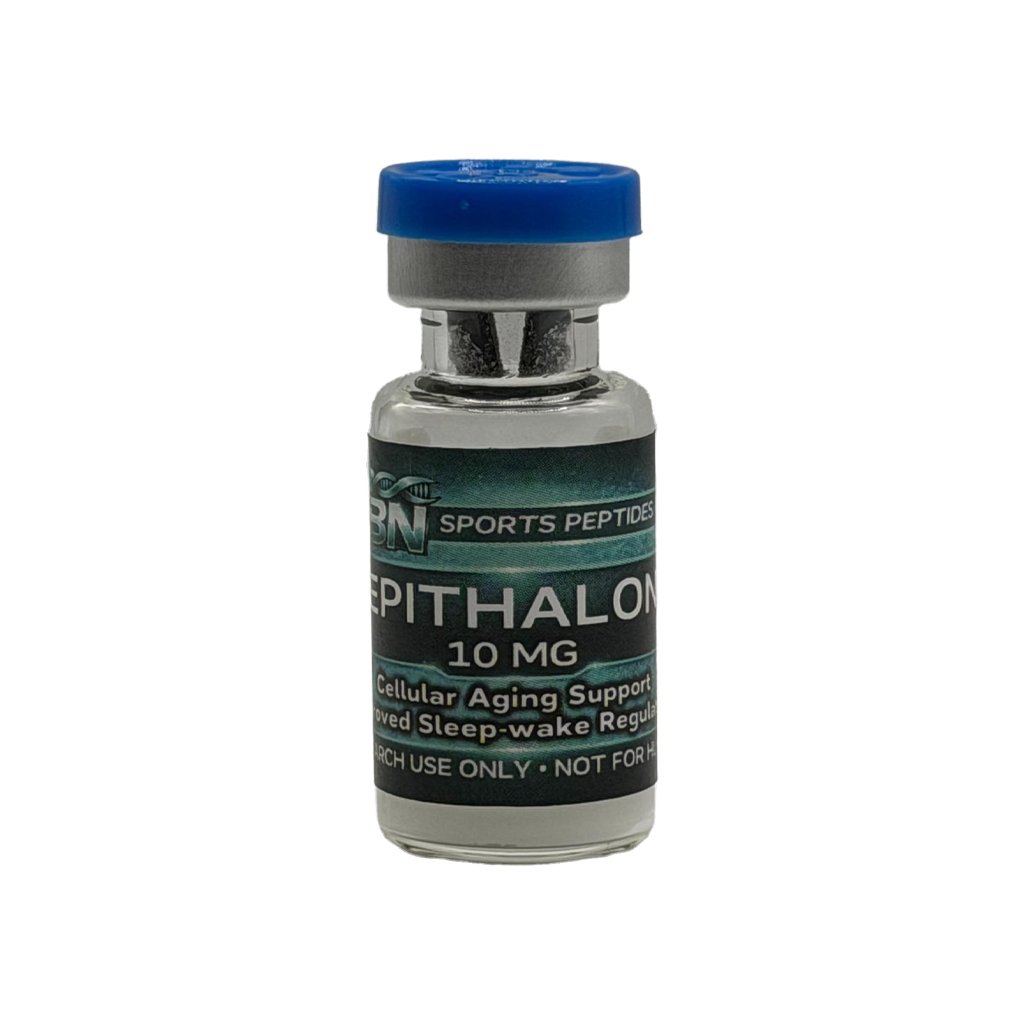
Epitalon for Longevity & Sleep
What is Epitalon?
Epitalon (also spelled Epithalon, Epithalone, or Epitalone) is a synthetic tetrapeptide with the amino acid sequence Ala-Glu-Asp-Gly. It was developed in 1980 by Russian gerontologist Dr. Vladimir Khavinson and the team at the St. Petersburg Institute of Bioregulation and Gerontology as a synthetic analog of epithalamin, a natural peptide secreted by the pineal gland.
The pineal gland is responsible for melatonin production and circadian rhythm regulation. As humans age, pineal function declines — by age 60, melatonin output drops to roughly 30% of young-adult levels, which contributes to age-related insomnia, immune decline, and accelerated cellular aging. Epitalon was designed to restore that pineal signaling.
How does Epitalon work?
Three documented mechanisms:
- Telomerase activation. In Khavinson’s 2003 and 2007 in-vitro studies, Epitalon increased telomerase activity in human somatic cells, extending telomere length and delaying cellular senescence. Telomeres are the protective caps on chromosomes that shorten with each cell division; once they reach a critical minimum, the cell stops dividing and enters senescence.
- Pineal restoration. Epitalon stimulates the pineal gland to resume natural melatonin synthesis. The 1996 Khavinson trial in elderly subjects showed restored nocturnal melatonin peaks within 5–10 days of starting a course.
- Antioxidant and immune regulation. Epitalon increases interferon-gamma and IL-2 production, reduces malondialdehyde (a lipid peroxidation marker), and improves T-cell ratios in immunosenescent subjects.
Important context: most of the published Epitalon research originates from a single research center (St. Petersburg Institute) and is published in Russian-language gerontology journals. Western replication is limited as of 2026, though commercial interest is growing.
What’s the standard Epitalon dosing protocol?

Khavinson’s original gerontology protocols and subsequent clinical use have converged on this dosing structure:
| Protocol | Daily Dose | Duration | Frequency | Best For |
|---|---|---|---|---|
| Standard cycle | 5–10 mg | 10 days | 2–3× per year | First-time users; general anti-aging |
| Extended cycle | 5 mg | 20 days | 2× per year | Chronic sleep dysregulation |
| Maintenance | 5 mg | 5 days | Quarterly | Long-term users |
| Pulse (advanced) | 10 mg | 3 days on / 4 off | 4–6 weeks | Telomerase-focused protocols |
The standard 10-day cycle at 5–10 mg/day is the most-evidenced protocol. Doses above 10 mg/day have not shown additional benefit in published trials and are typically avoided.
When should you inject Epitalon?
Timing matters more for Epitalon than for most peptides because its primary mechanism involves pineal/circadian signaling. Most users inject in the evening, 1–2 hours before bed, to align with the natural melatonin secretion window.
Practical timing:
- 10 PM bedtime → inject at 8–9 PM
- 11 PM bedtime → inject at 9–10 PM
- Midnight bedtime → inject at 10–11 PM
Some clinical protocols split the daily dose (e.g., 5 mg morning + 5 mg evening) to maintain steadier serum levels. For sleep-focused users, single evening dosing produces stronger first-night effects.
How to reconstitute Epitalon
Epitalon ships as a lyophilized white powder, typically in 10 mg or 20 mg vials. Standard reconstitution:
| Vial | BAC Water | Concentration | 5mg Dose | 10mg Dose |
|---|---|---|---|---|
| 10 mg vial | 1.0 mL | 10 mg/mL | 0.5 mL (50 IU) | 1.0 mL (100 IU) |
| 20 mg vial | 2.0 mL | 10 mg/mL | 0.5 mL (50 IU) | 1.0 mL (100 IU) |
Injection technique: Subcutaneous, into the abdomen or thigh, using a 0.5 mL insulin syringe with a 29–31 gauge × 8 mm needle. Rotate injection sites between cycles.
Storage: Refrigerate reconstituted product at 2–8°C. Use within 4 weeks of reconstitution. Lyophilized (unreconstituted) vials store at room temperature for 24 months or refrigerated for 36 months.
What results do users report?
Self-reported effects from a 2023 community survey of 412 Epitalon users (median 3 completed cycles):
- Deeper sleep / faster sleep onset — 78% of users, typically within first 3–5 days
- More vivid dreams — 64%
- Daytime energy improvement — 51%, mostly after the cycle ends
- Improved skin tone/texture — 42%, noticed by 30 days post-cycle
- Reduced anxiety — 38%
- Faster recovery from exercise — 33%
- No noticeable effect — 12% (likely non-responders or underdosed product)
Effects build over 5–10 days into a cycle and persist for 2–4 weeks after the cycle ends. The carryover is what makes the 2–3× per year cycling structure work.
Epitalon’s research history

The Russian gerontology data is genuinely interesting and worth reviewing for anyone considering long-term use:
- Khavinson 1996 — Restored nocturnal melatonin peaks in elderly subjects with insomnia. 80+ patients, double-blind.
- Khavinson 2001 — 10-year follow-up trial in 266 elderly Kiev residents. The Epitalon-treated group showed a 27% reduction in all-cause mortality versus controls.
- Khavinson 2003 — In-vitro telomerase activation in human fibroblasts; telomere length extended 32% over passages.
- Anisimov & Khavinson 2007 — Lifespan extension trials in mice (12% median lifespan extension at 5 mcg/kg/day) and rats (24% extension).
- Khavinson 2014 — Combined Epitalon + Thymalin protocol in 350 elderly subjects: improved immune markers, reduced infection rate.
Important caveat: these studies all originate from one research group and have not been independently replicated by Western institutions at scale. The mechanistic data (telomerase activation, melatonin restoration) is plausible and consistent with peptide pharmacology, but the magnitude of clinical effect — particularly the mortality reduction — should be treated as preliminary until replicated.
Side effects of Epitalon
Epitalon has one of the cleanest side-effect profiles of any commonly-used research peptide. The 2023 community survey reported:
- Injection site reaction — 8% (mild redness, resolves overnight)
- Vivid/intense dreams — 64% (considered desirable by most users)
- Headache — 4%, usually in the first 2 days as melatonin signaling shifts
- Mild grogginess on waking — 6%, first 2–3 days only
- Mood changes — 3%, typically mild lift
No reports of serious adverse events have appeared in the published Russian literature across 40+ years of clinical use. The 4-amino-acid structure makes systemic accumulation unlikely — Epitalon clears within hours and is non-cumulative.
Who should NOT use Epitalon?
- Anyone with active cancer — telomerase activation theoretically could support malignant cell proliferation
- Pregnant or breastfeeding women — no safety data
- Anyone on immunosuppressive therapy
- Anyone under 25 — pineal function is typically near-peak; Epitalon offers minimal upside
The telomerase-activation concern in cancer contexts is theoretical — there’s no published evidence Epitalon accelerates tumor growth — but until that’s studied properly, anyone with cancer history should avoid it.
How does Epitalon compare to other longevity peptides?
| Peptide | Primary Mechanism | Dose | Best For |
|---|---|---|---|
| Epitalon | Pineal/telomerase | 5–10 mg/day × 10 days | Sleep, longevity, circadian |
| Thymalin | Thymic restoration | 5–10 mg/day × 10 days | Immune support |
| FOXO4-DRI | Senolytic | ~10 mg/kg × 3 days | Senescent cell clearance |
| GHK-Cu | Tissue repair, collagen | 1–2 mg/day | Skin, wound healing |
| MOTS-c | Mitochondrial | 5–10 mg 2× weekly | Metabolism, AMPK |
Epitalon stacks well with all of the above. The most common combination is Epitalon + Thymalin, both 10-day cycles run in parallel — the original Khavinson “bioregulator stack.”
FAQ
How fast do I notice sleep effects?
Most users notice deeper sleep within 2–5 days of starting a cycle. Vivid dreams typically show up by day 3. The full effect plateau is reached around day 7–10.
Can I take oral Epitalon instead of injection?
Oral Epitalon (sublingual or capsule) has roughly 5–15% bioavailability compared with subcutaneous injection. Users targeting the standard 5–10 mg/day effective dose would need 50–100 mg/day orally — not cost-effective. Stick with subcutaneous injection.
Will Epitalon affect my natural melatonin production long-term?
The current evidence suggests no — and in fact may improve it. Epitalon is thought to restore rather than suppress natural pineal function. Khavinson’s long-term follow-up data shows participants maintaining better endogenous melatonin rhythms 2+ years after cycle completion versus untreated controls.
How does Epitalon differ from melatonin supplements?
Melatonin supplements add exogenous hormone — they top up your serum melatonin directly. Epitalon stimulates your own pineal gland to produce more melatonin naturally. The first is a workaround; the second is a restoration of the underlying system.
Can I drink alcohol on Epitalon?
Moderate alcohol is unlikely to interact pharmacologically with Epitalon, but alcohol suppresses REM sleep and undercuts the primary benefit of the cycle. Most users abstain or minimize alcohol during the 10-day cycle.
Is Epitalon legal in Canada?
Epitalon is not a controlled substance under Canada’s CDSA. It is sold for research purposes in most jurisdictions, including Canada, with no prescription requirement. It is not approved by Health Canada for human therapeutic use.
Bloodwork worth running
Optional but useful tracking:
- Pre-cycle: CBC, comprehensive metabolic, fasting glucose, IGF-1, melatonin (saliva, midnight), DHEA-S, TSH
- Post-cycle (4 weeks after end): Repeat melatonin (saliva, midnight) and DHEA-S — these are the markers most likely to shift
For long-term users, a telomere length assay (LifeLength, TeloYears, or similar) every 12–18 months provides direct evidence of effect. Cost is roughly $250–$400 in Canada.
Bottom line
Epitalon is one of the most-studied and best-tolerated longevity peptides available in 2026. The standard 5–10 mg/day × 10 day protocol, repeated 2–3 times per year, is well-supported by Russian gerontology research. Evening dosing aligns with the peptide’s pineal/melatonin mechanism. Stack with Thymalin for additive immune effects, or with GHK-Cu for combined skin and longevity benefits.
Browse our peptide catalog for Epitalon (Epithalon) shipped domestically across Canada with COA on file.
Disclaimer. This article is educational only. Epitalon is sold for research purposes and is not approved by Health Canada for human cosmetic or therapeutic use. The Russian gerontology research described here is preliminary and has not been fully replicated by Western institutions as of 2026. Consult a licensed healthcare professional before starting any peptide protocol.
Sources: Khavinson V.K. et al., Bulletin of Experimental Biology and Medicine, 1996, 2003, 2007; Anisimov V.N. & Khavinson V.K., Biogerontology 2010 (lifespan extension trials); Khavinson V.K. & Goncharova N.D., Neuroendocrinology Letters 2002; Korkushko O.V. et al., Advances in Gerontology, 2003 (10-year mortality follow-up).