

BPC-157 is the single most-discussed healing peptide in research today. Two decades of published studies, hundreds of peer-reviewed papers, and a remarkably broad regenerative profile have made it a cornerstone compound in tissue repair research. This guide covers what BPC-157 actually is, how researchers describe its mechanism, what the published research shows, and what Canadian buyers should know before placing an order.
What Is BPC-157?
BPC-157 stands for Body Protection Compound 157. It is a synthetic pentadecapeptide — a 15-amino-acid chain derived from a protective sequence originally found in human gastric juice. The body produces a parent compound with similar protective properties; BPC-157 is the isolated, stabilized research version.
The peptide is supplied as a sterile lyophilized powder. To use it in research, it has to be reconstituted with bacteriostatic water before any protocol begins. For step-by-step reconstitution, see our peptide reconstitution guide.
How BPC-157 Works (Mechanism)
BPC-157 does not act on a single receptor or pathway. Its research profile shows multiple parallel mechanisms working together, which is why it produces such a broad set of effects in studies.
- Angiogenesis stimulation. BPC-157 upregulates VEGF (vascular endothelial growth factor), which drives new blood vessel formation at injury sites.
- Nitric oxide system modulation. The peptide influences nitric oxide signaling, supporting vasodilation and reducing inflammation.
- Growth factor expression. Research has documented effects on growth hormone receptor expression, EGF, and FGF signaling.
- FAK-paxillin pathway activation. This pathway drives cellular migration and tissue remodeling.
- Tenascin and collagen regulation. Foundational for connective tissue repair.
The combined effect: faster, cleaner repair across tendon, ligament, gastrointestinal, vascular, and neural tissue in published animal-model research.
What the Published Research Shows
BPC-157 has one of the deepest published research libraries of any peptide in the healing category. Documented effects in animal-model studies include:
- Accelerated tendon-to-bone healing
- Enhanced ligament repair
- Improved muscle injury recovery
- Faster gastric ulcer healing
- Reduced intestinal fistula formation
- Neuroprotection in models of brain injury
- Enhanced peripheral nerve regeneration
- Cardioprotective effects in ischemia models
- Improved endothelial function
Most research has been conducted in rodent models with smaller human pilot work. Robust large-scale clinical trial data is limited.
BPC-157 Dosing in Research Protocols
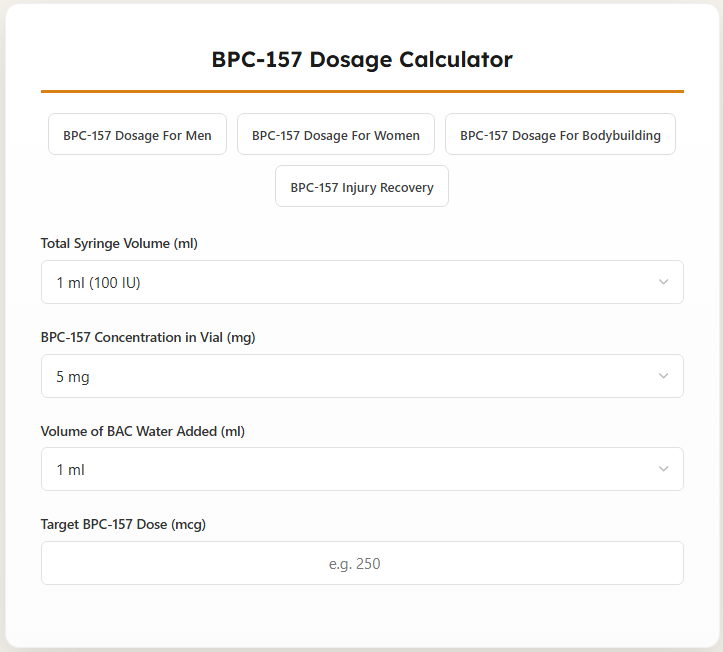
Published research and self-report data describe BPC-157 protocols in the 250 to 500 mcg per day range. Some research designs use doses up to 1000 mcg per day for acute injury models. Protocols typically run 4 to 6 weeks with morning and evening administration to keep serum levels stable.
For the math on converting from mg vial concentration to mcg syringe dose, see our reconstitution guide which includes the full dosing breakdown.
BPC-157 Stack Combinations
BPC-157 is commonly studied alongside other recovery peptides because its mechanism is complementary rather than overlapping. The most common research stacks include:
- BPC-157 + TB-500: The classic regenerative stack. BPC-157 drives angiogenesis and growth factor signaling; TB-500 drives cellular migration through actin regulation.
- Wolverine Blend: Pre-mixed BPC-157 + TB-500 in a single vial for researchers who want both compounds without separate reconstitution.
- BPC-157 + GHK-Cu: Pairs the gastric pentadecapeptide with the copper tripeptide for skin and connective tissue research.
Storage and Stability
BPC-157 storage protocols match every other research peptide:
- Unreconstituted vials: Freezer at -20°C. Stable for 24+ months.
- Reconstituted (mixed) vials: Refrigerator at 2-8°C. Use within 30-45 days.
- Avoid: Freeze-thaw cycles on reconstituted product. Direct light exposure. Heat.
Quality and Sourcing in Canada
The Canadian research peptide market has matured significantly. Quality matters more than price — a poorly synthesized BPC-157 batch will give unreliable research results no matter how cheap it is. Look for:
- 99%+ HPLC-verified purity with a published or available Certificate of Analysis
- Sterile lyophilized powder, not pre-mixed liquid
- Cold-chain Canadian shipping (avoids customs delays and degradation)
- Transparent batch and lot tracking
PeptideFire ships BPC-157 10mg direct from a controlled Canadian cold-chain, manufactured to 99%+ HPLC purity. See our Healing and Recovery Peptides category for the full range.
Side Effects Reported in Research
BPC-157 has one of the cleanest published side-effect profiles in the peptide research space. Most animal-model studies report minimal adverse events at standard research doses. The most commonly reported observations in self-report data include:
- Mild fatigue in the first 5-7 days of a protocol
- Minor injection site reaction (redness, soreness)
- Rare reports of dizziness or headache
- Possible mild blood pressure shifts
For broader peptide degradation indicators and how to spot a bad batch, see related guides in our PeptideFire library.
BPC-157 FAQ
How long does BPC-157 take to show results?
Published research documents measurable tissue-repair effects within 2 to 3 weeks of protocol start. Effects typically continue to build through the full 4-6 week cycle.
Does BPC-157 need post-cycle therapy?
No. BPC-157 does not suppress endogenous hormone production, unlike anabolic compounds. PCT is not required after a protocol.
Can BPC-157 be taken orally?
Most research uses subcutaneous or intramuscular injection. Oral BPC-157 research exists but absorption is significantly lower and less predictable.
How does BPC-157 compare to TB-500?
Different mechanisms, complementary effects. BPC-157 drives growth factor and angiogenesis signaling. TB-500 drives actin polymerization and cell migration. Most regenerative research stacks use both.
Where to Buy BPC-157 in Canada
PeptideFire stocks BPC-157 10mg vials at 99%+ HPLC-verified purity, supplied as sterile lyophilized powder with Canadian cold-chain shipping. Pair it with TB-500 or grab the Wolverine Blend for the pre-mixed stack. Sold strictly for in-vitro research only.
Sources
- National Library of Medicine — BPC-157 published research
- Frontiers in Pharmacology — Pharmacology research journal
This content is provided for educational and research-reference purposes only. BPC-157 is sold strictly for in-vitro laboratory research and is not approved for human consumption in Canada. Consult a qualified healthcare professional before making any decisions about peptide research.